Some think that we climb for the exercise. This is sort of similar to climbing to eat. But, yes, there's nothing like a climb up (and down) on a mountain for some good, wholesome, exercise. Feels great, and I've no problem sleeping, afterwards. . .
Some think that we climb to die. After all, that's what many see on the news. 3 climbers climbed Mount Hood last December, and one was found dead on the summit, and the others are still up there, somewhere. And years ago, many, all over the world, saw the helicopter do a nose dive and fall into pieces, rolling down that same Mt. Hood, when trying to lift off a severely injured climber from a climbing accident that left 3 dead and several wounded. So, surely, climbing is to die, right?
Many of my friends are definitely puzzled about why I climb. There are so many reasons - it's just plain FUN. It's exercise. It's about being outside. It's about being in nature. It's about challenge, sometimes. It's about the sheer joy of being on the summit of a mountain and looking down and around at all of the other mountains, seeing everything from a different perspective, seeing things that most people never get a chance to see - the crevasses, the glaciers, the wildflowers, the rime ice covering the rocks, the boulders/rocks/rock spires, and it's about sharing all of that with others.
Having the ability to climb, and being at least moderately good at it, allows me to share this opportunity with others. I've taken several people up South Sister, a 10,000ft peak in Central Oregon, just so that they, too, can have "climbed" a mountain, see a glacier up close, and experience the joy of being up so high and looking down. I've also taken people up Mt. Hood. My second climb this year was up the south side of Hood, and specifically to help two guys, David and John, meet one of their life's goal of climbing that mountain.
In Oregon, climbing Mt. Hood tends to be a fairly popular life goal, since the mountain is there, every day (whether or not you can actually see it, since it's usually cloudy, here!), looking bold and beautiful, the tallest thing in the Oregon sky. It beckons to people. And it's not just the walk-up that South Sister is, although one CAN frequently "just walk up" the south side. One should have a few skills before going up, and, there is what we call "exposure" - it gets steep at the top, and if one slips, one can go many hundreds of feet, before coming to a rest, unaided. Hence, it's good to have some skills before going up. David and John did have some of the basic skills, and we'd all done Mt. St. Helens the previous weekend, with another experienced climber, Duane, so this shorter, but more technical climb, was just a next step.
The lower part of the climb was no problem for anyone, just a matter of placing one foot after the other. There weren't so many people on the mountain, which was rather surprising as this was the beginning of May, where there is usually a stream of climbers going up. Above the Palmer ski snowfield, the climb gets markedly steeper, and crampons are usually in order, as they were this early morning (I think that we left at midnight). The next 1500 ft are fairly easy, especially if someone has already kicked steps, which someone had - so that we were able to put our feet flat on each step. Then, there's the walk around Crater Rock - a huge rock coming out of the center of the crater that is the whole top of the mountain. While going around this huge rock, the terrain is very steep, and on our right we could look down and see the steaming "Devil's Kitchen," a place where Mt. Hood vents - one can smell the sulphur that is exuded from those vents. This is the first place that it gets really steep. I usually stop to eat just before this, as it's inconvenient to stop while on this part (too steep). A climber in front of me heard me telling the others that I was going to grab a bite to eat and turned around and said "the Hogsback is just over there!" Yes, I know. The Hogsback is a flat ridge of snow where everyone rests before the final summit push. This is where everyone ropes up, if they're going to, or unropes if they're coming down. And it takes a while to get there from the just below Crater Rock, and I see no reason to go without food to reach it (after all, climbing IS about eating!). Anyway, we ate a bite and then trucked on up to the Hogsback. At this point, we could look down onto the side with the Hot Rocks, where the helicopter mentioned earlier, had rolled down, or, on the side we were on, down into Devil's kitchen, or up to "the Pearly Gates." Steep in all directions. It was here that one of the guys said "I can't do it." He'd gotten dizzy just going around Crater Rock. He looked up, saw the steepness, saw the exposure, and decided that this was a good stopping spot for him. I remembered my own similar experience years ago when I'd begged my friend, Peter, to take me up a mountain, and he dutifully tried, but when I got to a place over a cliff - I couldn't go any farther. It didn't help to have Peter tell me that, look, I'm not going to go very far, even if I were to fall - I'd stop before I got to that cliff. Nope. I'd just heard about a fatal accident on Mt. Hood in gory detail from a friend whose husband was involved, and that had translated into paralyzing fear in this particular instance. I couldn't go further, and we had to turn around. I'm sure that I wouldn't even notice that "exposure," now. So, it was very undersandable, hearing this same sort of thing from my friend, now. There would be another time, and I'm sure that he'll be able to do it. Meanwhile, David was still itching to get up there. We looked at the conditions, and they were good. The bergschrund (crevasse in a specific place) was only slightly open, with a good snow bridge over it, and the snow was good - we should be able to self-arrest if one of us should slip. We were three of us, David, Duane, and I, and we elected not to rope up. We walked in the footsteps of the people before us, to a flat place where we either had to go right through the Pearly Gates, or left through what one guide had told me was called "the Chute." I'd heard reports from others who'd gone up previous weeks, and turned left, heading up the chute. It was quite steep, and just one person wide. I went through, then David, and then Duane. David stopped to take this picture at the top of the Chute (still another hundred or so feet to go to get to the summit) - the camera didn't work so well without full light when looking down onto Duane, so it's a bit blurry, but it gives you a good idea of the situation, I think:

We summitted, and David was thrilled! And I was thrilled to have helped him get there! We still had half the trip, yet, to go - getting up is great, but most of the accidents happen on the way down. We downclimbed through the Chute, to the flat spot. I looked up, saw a huge chunk of ice, just being hit by the morning sun, and dallied no longer, heading down. I didn't hear footsteps behind me, so turned around and saw Duane and David standing there on the flat spot. I yelled to them about my concern about the ice above them - they looked up, and immediately made their way down. David had stopped on the way up in this same spot to take this shot:

That line of snow in the middle of the photo is the famed Hogsback running right into Crater Rock, with one of the 3 dots along the Hogsback being John, waiting for us. Further down on the left of the photo, you should be able to make out the straight line of the Palmer ski lift. That lift heads down to Timberline lodge, and the Day lodge. We'd a ways to go before we could call the whole thing, successful. And down we went, and successful we were. I was very happy to have been a part of allowing David to meet one of his life's goals. It made me happy to be competent enough at climbing to do such a thing for another.



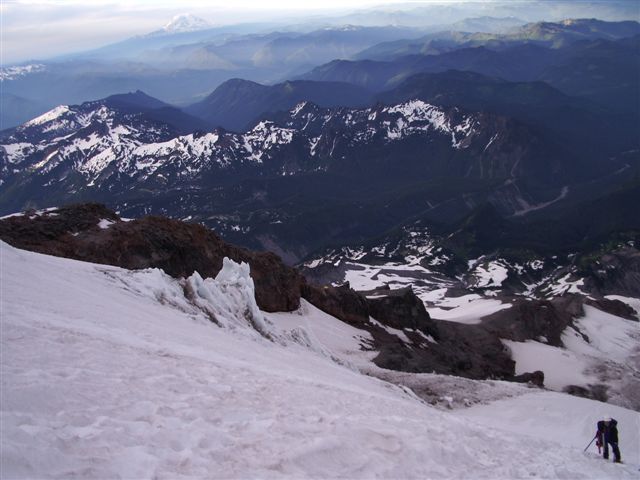

 and here:
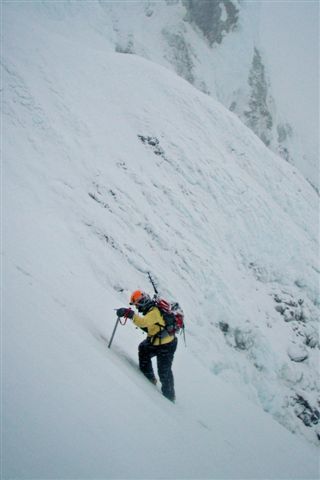
 (this 2nd picture taken from "the Hogsback" on the south side of Mt. Hood, and looking east to where we'd gone up several hours, earlier.) The pictures for this climb are all compliments of one of the guys (Chris) in my class, who was on the other rope. We had 3 people to a rope, and 2 ropes in our group, and 5 people on one rope for the other group that went up a different route. The assistant for our Advanced Snow class was our group's climb leader, and he's the one who put in our "protection" - pickets buried in the snow, while climbing up the steepest part of the East Crater Headwall route. Since I was the last on the 2nd rope team, I "cleaned" the route, that is, I took out all of the pickets. You'll see them hanging off of me in another picture near the summit, later.
 Looks really cool, doesn't it?
 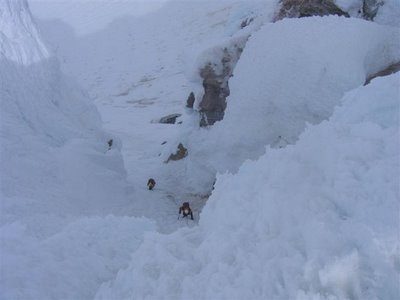 Also pretty cool, eh? However, that wasn't, in my opinion, any big deal. The big deal, again, in my opinion, had yet to happen, and consisted of climbing around the gendarme (the peak-looking thing) that is pictured, here:
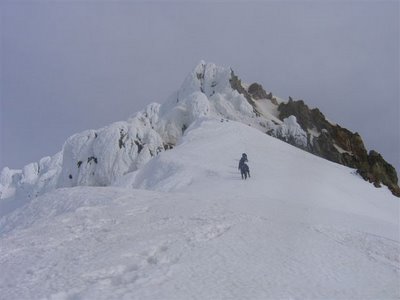 Doesn't look like such a big deal, does it?
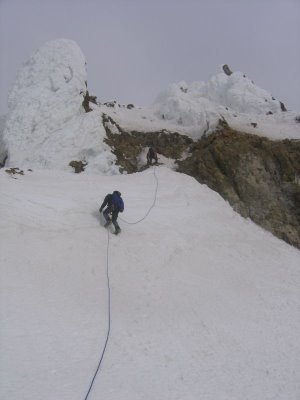 His job (besides just climbing) is to put in protection for both of our teams, which now consisted of 3 rope teams. Again, I was last, and so the "cleaner" of the route, not wanting to leave any of our gear on the mountain. Now, this innocent looking little peak is very near the summit of the mountain. This means that it's high. On the back side of it, it drops down thousands of feet. When there, it looks like straight down, for those of us who haven't yet climbed vertical waterfalls (that's left to the Advanced Ice part of the class). . . I was sure that I would fall. I was hoping that my rope mates were paying attention, and that protection above me was firmly in place. Every time I put my foot down on some snowy ice crystals, I wondered if it would hold until I got my next foot placement. It was also at this time that I realized that I didn't exactly know how to use the "2nd tool" that I'd been given as part of this class. It's a shorter ice-axe looking piece of equipment. I whacked at the ice and rock, and when it stuck, I used it as leverage to pull or push myself up and around what appeared to me to be a rock face. Going around it, I saw a carabiner hooked into what looked like a bolt for sport rock climbing. In my altitude-induced wonderment, I was surprised that someone had "bolted" the route (it's a wilderness area - there are not supposed to be any bolts, here), and, furthermore, that David had actually found the bolt. I unhooked the carabiner, sling, and other carabiner that were attached to it, thinking that this was the best protection that I'd seen, yet, on the climb, and so sad to say goodbye to it, since that meant less protection, should I now fall. I looked down. I decided that that was a mistake, and decided to pay more attention to continuing the route around and up. The next part of the climb is pictured here:
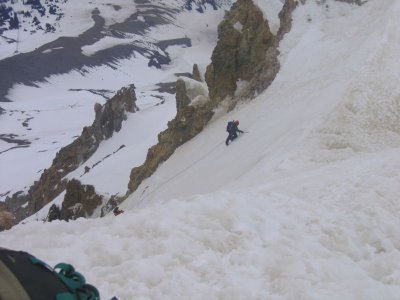 where my rope mates are already on the other side of the gendarme, making their way to a ridge of snow, where they then sat and belayed me as I climbed up. In the next picture, you can see them in almost the same position, but you can see more clearly the snow ridge to which they were headed, and the nice drop off to the south side of the mountain from that snowy ridge. It's so hard to tell that the land that you can see in the distance behind them and downward is really, really, really far:
  Notice the rope between the two of my rope mates. They are some 60ft apart from each other, and I am another 60 ft behind the 2nd guy. When we got to the snowy ridge, the guys suggested that I lead the rest of the way to the summit, which was now a rather gentle slope up. Chris, on the summit, already, took a snap of me and my rope team!: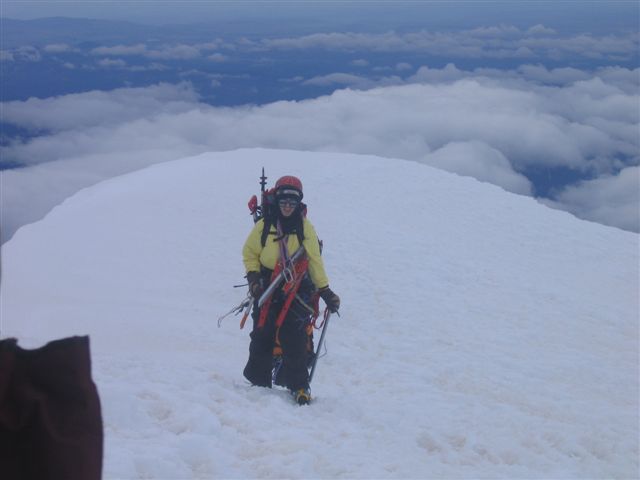



 leora
leora
 (these characters might not show for some of you)