Saturday, October 22, 2011

Anticipati​ng Antarctica

Back in May, I mentioned that this year’s big trip is to Antarctica for celebrating the 11/11/11 birthday of my travel buddy, Ed. Well, the trip is almost upon us.

The plan is for the two of us to meet up on November 2nd at the Dallas-Fort Worth airport in Texas (me flying from Oregon, and Ed from Arizona), and then flying on into Buenos Aires, Argentina, where we have to switch to the domestic airport across town (we’ll probably take a taxi), and then on to Ushuaia, at the very southern tip of Argentina. We should make it to that town around 6:30 in the evening, enjoying the spring season, which should be well under way, down there. In a move that is a little against our tradition, we’ve reserved a hotel for the whole time that we’ll be down in that town.

Ed and I were talking about the location of Ushuaia – it’s at the 55th parallel in the southern hemisphere. I couldn’t find any notable towns in Canada that appear on the corresponding parallel in North America. It’s sort of the southern tip of a little finger of Alaska, and is halfway through provinces like British Columbia and Alberta. In Europe, it’s a little north of Belfast, Ireland, and runs pretty much through Newcastle in the U.K. It’s roughly the southern tip of the Scandinavian Pennisula, and runs through the southern part of Russia. It’s just fun to consider where we’d be in the northern hemisphere if we were near the corresponding parallel.

We expect that we’ll be doing some hiking and exploring while in the area, and then we get on the One Ocean Navigator (also known as Akademik Ioffe) on the 8th with about 94 other passengers. I’m hoping that we’ll have a night of calm channel travelling, before the 2 days of rough Drake Passage crossing in order to get to the tip of the Antarctic Peninsula – an arm of land that looks as though it was torn off from the mainland that lies to the east of the peninsula. We’re hoping that we’ll be able to actually touch the continent on Ed’s birthday on the 11th. If everything goes as planned, we expect to spend up through the 17th doing sea kayaking, snowshoeing or hiking, and at least one night camping out. The whole point of going with this particular company was to be able to be active while down there. We may or may not get to cross the Antarctic Circle. We’re expecting that the weather and existence of ice in the water to play a big part in determining where, exactly, we’ll be going after getting to the peninsula area. And no, I won’t be doing any climbing while there, which is sad, as there are quite a few nice mountains, in Antarctica, and some on the peninsula, itself.

I think it’s on the 18th, we have to turn around and head back to Argentina. We’re expecting to go from the boat to the airport on the 20th, and spend the entire day getting over to Mendoza, Argentina, where Ed wanted to spend a few days. I’m hoping that we’ll get a whitewater rafting trip in, while there, before we take off on the 25th for the long trip back to the US, which is routed through Miami, Florida.

We’re both hoping that between what we’re bringing, and what the boat is providing (waterproof parkas and bibs, Wellington boots, and dry suits for the kayaking), that we’ll always be nice and toasty warm. Besides, it’ll be Spring! In spite of the season, something that I read mentioned that the water is just about 32 degrees Fahrenheit (0 Celcius), so I’m really, really, really hoping that there will be no splish-splashing around in the water!

They say that we’ll take about 4 or 5 times as many photos as we plan on taking, so I hope that I’ll have enough memory in my camera. I’m also hoping that Ed will take his normal array of spectacular photos. I’m beginning to expect that I’ll have the crappiest camera on the boat, but it’s small, supposedly waterproof and shockproof, so it quite suits me with the paces I put it through. . . .

Don’t expect any email while I’m down there!

Oh – I have written up some of my summer climbs, but they’ve all been written as trip reports, or discussions on www.CascadeClimbers.com, so written for consumption by mountaineers. If you’d care to take a gander at them, one is here: Failed attempt at Glacier Peak, another here: Steel Cliff Route up Mt. Hood, and another writeup in the comments at the very end of this post Adams Glacier route up Mt. Adams. This last climb was one of my favorites this summer, since it was technical, involved a lot of route-finding through the crevasses, with no assurance of success, and had fabulous weather. My partner was also able to take what I thought was a great picture of me on a snow bridge, in the middle of a huge crevasse in what we were hoping was a route out of the crevasse field:


Looking forward to touching the, and my, 7th continent,
leora

Thursday, July 07, 2011

A couple of trip reports

These trip reports were designed for mountaineers, but I thought that I'd put links to them, here, since some folks might be interested in reading them.

This one is about a less-often done route up Mt. Hood, Steel Cliff:
http://cascadeclimbers.com/forum/ubbthreads.php?ubb=showflat&Number=1023692

And this one is about a failed attempt at a mountain in the Northern Cascades, Glacier Peak:
http://cascadeclimbers.com/forum/ubbthreads.php/topics/1025177/What_should_have_been_a_Glacie#Post1025177

Safe travels. . .

leora

Sunday, June 19, 2011

The Universe Delivers

Many times, I feel just plain lucky. I choose to say something, and discover something helpful. I’d like to think that those times outweigh all of the times I choose to say something that I later regret. . . This missive is about one of the fortunate times.

One of the guys at work, Matt, was having a devil of a time trying to get an opportunity to climb our local, highest mountain in Oregon, Mt. Hood. He took the local mountaineering group’s basic mountaineering class (something I’ve helped to teach in the past), and signed up for a climb. I was going up every weekend to either climb or teach, and he was maybe climbing to the top of the Palmer snowfield (which is really the start of the significant climbing of Mt. Hood), and turning around and going home, or his climb was being cancelled for one reason or another before even getting to the mountain. 2 weekends ago, I was trying to get someone to climb a technical route with me, and failed, so I asked Matt if he wanted to accompany me for a south side ascent (the most climbed route). He jumped at it. We had great weather, including high clouds that kept the sun off of the top of the mountain until we could get up there, thus avoiding the dangers of ice falling down onto us.

Here are a couple of shots of the sunrise:


And:

That’s Mt. Jefferson peaking out through the cloud mass that the sun is lighting up.

We were successful and had just stunning views of all of the surrounding mountains, and the cloud shrouded valleys, below. We headed down, and got to a safe spot, the Hogsback. Matt was telling me how beat he was. He ate, and I suggested that perhaps a snooze was in order, as soon as we got to the base of Crater Rock, out of the way of any possible avalanche, ice, or rockfall danger, since the sun was blazing at this point. We went down to the base, and tried to snooze for about an hour. We then headed down, with Matt telling me that he was having a splitting headache, and no amount of water seemed to get rid of it. As we got down to the top of Palmer, with 2 miles and about 2,200ft in elevation still to go, he told me that a migraine was coming on, and that he wanted to put a wet towel on his head and sleep in the dark, but all we had was bright sunshine and a ways to go. I started to wonder if there was *anything* that I could do to help him. I realized that I could take his backpack, and then he would just have to worry about getting his body down. I took his pack, and strapped it on my front. He’s a tall guy, so it stuck up a bit, but wasn’t really much of a problem – with all of the water he’d drunk, it was pretty light. We kept going down. With a little over a mile to go, and still another 1000ft left to drop, we came across two guys taking a lot of pictures. One of them turned to us with that “can you take a picture for us” look in his eyes and he may even have asked it, aloud, and I answered him, that of course I’d be happy to do so. I took their picture with the top of the mountain behind them. They started asking questions about what we’d done, and I was answering. Matt was suffering. We turned around to go down, as did they, but they were still behind us. I decided that I wanted to know where they were from, since they’d been speaking another language when we’d approached, and were obviously tourists. I yelled back the question about where they were from, and they called back “Israel.” I’ve been there, years ago, and despite having relatives there, which should make it more attractive to me, just didn’t care for the heat. Just like Florida, I have a hard time returning, and have yet to. I told them about that, and then mentioned that we have a team of Israelis whom we work with at my company. I so rarely mention what company I work for. I don’t know why – perhaps because many people, in places I’ve visited, give me a blank stare when I do . . . This time, I thought, let me just mention the company. I told them that I work for Intel. They both piped up, “me too!”

We started chatting about all of the people we know, quickly establishing that we knew some of the same people. And, finally, we got around to exchanging our own names. One of the guys, Muhammad, offered to reduce my burden by taking Matt’s backpack from me. He was happy, because he felt like a mountaineer, and I was happy, because it was easier to see without it. As we continued down, I started thinking about the ride home. I’d not gotten any sleep the prior night. I’d woken up at around 6am on Friday, worked all day, and tried to sleep at a colleague’s place, but was never successful before having to pick up Matt at 10pm, and starting our climb at midnight. At this point, it was nearly 3pm the next day, so I’d had 33 hours of no sleep. I told Matt that I was sorry, but I would have to sleep some before I would be able to drive home, so his agony would continue, since for sure, he was not able to drive. Steed, the other Israeli, piped up that he and Muhammad could help drive. At first, I thought that this sounded impossible, but then I realized that they would have just 1 car between them, and could split up, with one driving me, and the other Matt, since likely, they would be staying somewhere on my way home. I asked if they could drive a manual transmission. Of course, they could – they didn’t grow up in the US, where automatic transmissions are the norm!

So, when we got to the parking lot, we moved Matt’s stuff into Steed and Muhammad’s car, so that Muhammad could take Matt home, and Steed took over the driving of my car. As I curled up to go to sleep in my car, with Steed driving, I thought of my friend Mary and what she would say to this, “you had a complete stranger drive your car while you slept!!!!! Are you crazy??!?!? “ I told Steed about this thought as I went off to sleep, and his only comment was “I never did show you my badge!” (He was referring to the Intel badge that we all get as proof of our employment.) He dropped himself off at his hotel in Portland, and by then I’d had enough sleep that I could make the 3/4s hour drive back home without incident.

Steed and I wound up going hiking the following day with one of my interns, with Steed driving his rental car. We returned really late, and Steed got tired while driving, so I took the wheel (fortunately, any Intel employee can drive an Intel employee rented vehicle), and as I did so, mentioned that I was happy to be able to repay the favor from the previous day!

Here’s a picture of me from after that hike, with Coldwater Lake behind me, and some of the low mountains north of Mt. St. Helens:


I’m still amazed at how well this all worked out. Oh, and Matt recovered, nicely – just slept the whole way home, and then that night, and felt quite fine, and very happy that he’d climbed his first mountain, and Mt. Hood, at that.

May the universe put out friendly tentacles, at just the right time for you, too.

leora

Thursday, May 12, 2011

The Good, the Bad, and the Tragic

The good news is that my travel buddy and I are going to celebrate his 11/11/11 birthday by traveling to Antarctica!!! We'll be flying to Buenos Aires, Argentina, and then on to Ushuaia, at the very southern tip of Argentina, where we'll hop on a boat, take off across the dreaded Drake Passage (everyone tells me that it's very rough!), visit a sort of arm of land that projects out from the continent, called the Antarctic Penninsula, do some kayaking, and, if the weather permits, an overnight campout on the continent, a little more kayaking, and then return back to Ushuaia. We'll be on a ship called the One Ocean Navigator (also known as Akademik Ioffe) and get to spend about 6 days wandering around the Antarctic Peninsula.

The bad news is that we've had to postpone the Denali expedition until next year, due to Candi's back injury. She's spending the year getting her back up to snuff. Meanwhile, Tom and David are climbing Denali, now, as I write this, with a guide service. Candi, Oleg, and I are currently planning to climb Denali as a threesome, with which Candi is now comfortable. This makes the planning, skills practicing, communications, and likely the whole climb much simpler. It does narrow the safety margin a bit, so practicing together will become even more critical. We did a navigation practice several weekends ago, climbing Mt. St. Helens in a whiteout, which was really fun. There was only one other team on the mountain. I put some wands in on the way up, and we took compass bearings and made a mental note of the altitude of each wand. There was one wand in particular, in the middle of a vast snowfield, that I never expected to see again, on the way down, because we spaced them so far apart, so that relatively vague readings on the compass would get us near, but perhaps not near enough, in such whiteout conditions, to make out a wand, but we found them all, which was quite gratifying.

Our summit shot gives some indication of the low visibility:

Can you see the edge of the crater rim behind me? I sure can't! And in case you can't tell, I'm the one standing, and Candi is sitting.

Now, compare the above to what it looked like on a clear day, earlier in the year, when I went with my friends Rita and Gil:


This was taken looking east, where you can see the edge of the rim in the near distance, and Mt. Adams in the far distance. (JM stands for "Juvenile Myositis.")

The tragic news is that my wonderful next door neighbor, Steve Allen, was killed, yesterday, in an explosion of something called an hydraulic accumulator that he was working on at his work place, Stimson Lumber. It was apparently under pressure, when it wasn't expected to be. This was the neighbor of whom I wrote in an earlier leoralore, when I was having my water difficulties. Steve didn't like to hear about my climbing exploits, because they made him too nervous. . . Little did we know, when we discussed my climbing, that his work would wind up being so deadly. He was a truly wonderful man. He touched many lives, and always in such positive ways. It's heart-wrenching to have to talk about him in the past tense.

Please, all - stay healthy and alive.

leora


Monday, January 17, 2011

Denali: Background and Another Snow Session

By the comments and questions I received, I realized that I didn’t set up my Denali Planning leoralore very well. . . I got the most “grief” from my uncle who told me of his surprise that I would be “climbing” a Denali (Chevrolet Sports Utility Vehicle) or an Expedition (a Ford SUV). Although he was kidding me, I went back and read that missive and noticed that not once did I ever refer to it as a mountain! So, let me introduce Denali, properly!

Denali is also known as Mt. McKinley. It’s located in Alaska, and it’s the tallest mountain in North America at 20,320 feet (6193 meters). Being the tallest, it’s also a magnet for people all over the world who want to summit the tallest mountains on each continent. So, there will be a lot of us on the mountain. . . For us, the plan is to start our trip sometime in May of 2011, and finish sometime in June, reserving an entire 4 weeks to do the trip, including taking all of the flights. The expedition starts at 7,200ft (2195m) on the Kahiltna Glacier, where we’ll be dropped off by a small plane that has us and our gear. We then plan on climbing the 15 miles (24 kilometers), with about 13,120ft (4000m) elevation gain, to the summit via the most common route, the West Buttress. If we’re lucky, the entire time on the mountain will be around 16 days, but if there are storms or what not, it could take longer, hence the reservation of 4 weeks. . .

So, that’s the background information. In November, we did a snow session practice on Mt. Hood with four of the six of us. Both Oleg and Tom were on international trips, so couldn’t join us. Candi and I went on snow shoes, and Denis and David went on skis.

Here is Candi gearing up. Her and my snowshoes are at her feet, and she’s putting the finishing touches on getting her backpack ready, while mine is lying behind her:

Denis and David were able to hustle up much faster than Candi and I were:

Candi is the obvious person in the picture, and Denis and David are the two dots dead center in the picture, near one of the ski lift pylons. Our visibility came and went throughout the afternoon. Mostly, it went. . . However, it cleared up as we set up camp, giving spectacular sunset views:

And the top of the mountain became visible:

Soon after this picture (that’s the back of Candi’s head), we had dug out platforms in the snow for our tents, tied them down, and had gotten started melting snow for water, when the moon came up in the east and the sun went down in the west at the same time! I took pictures, but they didn’t come out, well, so imagination is probably better than lousy pictures. . .

With the weather looking so great, and the snowpack looking pretty great, we decided to try to make it to the summit the next day. We were camped at about 8,650ft, which seemed so low to me, that I didn’t bother to make sure that I was properly hydrated. I just wanted to get to bed and make sure that I got enough sleep before attempting to climb early (5am) the next morning (everyone wanted to get back home, early, so we had to get up early to do the climb to make it back down in time).

Both Denis and David woke up before 1am and took in the fact that there was a full moon and clear skies. They also noted that it was quite cold, but knew that it wouldn’t get much warmer and decided to make the move to summit, then, instead of going back to sleep to get up at the previously agreed upon time. I was feeling like crap, so I was thinking more sleep would be nice, but I had been cold (a 40-below sleeping bag just doesn’t seem to do it for me, unless I also have an inner bag!) all night, and didn’t think that it would get much better, so, yeah, what the hey – I decided to give it a shot, then, too. Candi agreed. We all started up, and I was as slow as molasses. Candi stayed back with me, and Denis and David skied steadily up and out of sight. When I got to around 9600ft (2926m), I threw up! I thought of Joe, who’d gotten ill just around this elevation a couple of years ago, and the 3 of us who were climbing “with” him, not noticing and trundling on up. . . At the time, I couldn’t believe that he’d gotten Acute Mountain Sickness (AMS) at such a low elevation – yes, it’s certainly POSSIBLE, but I’d never known anyone who did – at LEAST make it to 10,000 ft (3048m) before succumbing to AMS if you want to call yourself a climber, for Pete’s sake!!!! Anyway, here I was at 9600ft, and retching. I was pretty sure that there was nothing that I could do to make myself better enough to keep climbing, so I called up to Candi and told her that I was turning around. She told me she’d join me, even though she was feeling very strong. I ran down about 100ft just because I thought it would help me not to retch, anymore, and used my cell phone to leave David a message that we were turning around (fortunately, the cell phone SOMEtimes works on the south side, and it appeared to be working, then). I had no more AMS issues, and by the time Candi and I arrived back at camp, the sun was rising:

We took a “Cure JM” (Cure Juvenile Myositis – the disease for which we are hoping to raise research funds with the Denali climb) picture to the east. Yes, that’s a sea of clouds, below us, in the distance behind Candi. And Candi is quite bundled up because we judged it to be around 14F (-10C), or possibly colder.

The guys turned around at the Hogsback due to super-deep snow, and met us just as Candi and I were leaving camp. Since their trip down was going to be faster on skis, we took off, doing some gear exchange with them when they passed us on their way down.

As a practice session, it wasn’t the best, since we pretty much didn’t practice anything that we would need to do on Denali, except deal with cold and melt snow for water. If I needed a reminder, which, apparently, I did, that hydration is important, I definitely got it. But it was ok that we didn’t practice any of the other stuff that we’d need to do on Denali, since we intended to have other sessions later in the 2010 year, and in 2011, including everyone. However, as what happens with expeditions many times, things change. Our December session didn’t happen, because Denis dropped out (an expected change in jobs wasn’t going to be conducive to taking a month off), David and Tom got busy, and Candi sprained her back.

Soon after, David and Tom dropped out, deciding that they would go, instead, with a professionally guided group. This increases the chance of success of the climb, so it’s quite understandable. However, it’s not the type of climb that I’m interested in. I told Candi about this newest development, thinking that she would still insist on 6 people for the team, and I was ready with a bunch of ideas about how to obtain the additional 3, but to my surprise, she’d already thought about just doing a 3 person climb, and was now ok with the idea. Three people climbs are a HECK of a lot easier to arrange, plan, practice for, etc. On the actual climb, we won’t have the added security of having an additional team to help haul out us out of a crevasse, should one of us fall in, and we won’t have as many options if one of us gets ill, but the coordination and preparation, which are a pretty huge part of the expedition, will get much, much easier.

However, Candi still has a sprained back.

So, are we going, or not? Well, we don’t know. We’ve decided to give it until the end of January. If her back is fine at that time, then we will go as originally planned. If it’s not, then we’ll be forced to put off the climb for a year.

There are advantages for me, personally, either way, so I’ll just wait until the end of January for that decision, and meanwhile, continue the planning and getting ready, as if I were to go, since some things need to be done whether it will be this year, or next year.

May your dreams come true!

leora

Tuesday, December 14, 2010

Snow, as ordered. . .

When I booked my trip to Michigan in December, I was actually hoping that there would be snow, but I guess that I was hoping that it would already be there. Instead, there was snow when I landed, but just a dusting, and that’s about how much there was until, of course, I was supposed to leave. Saturday night, the weather first got warm (a few degrees above freezing – it’d been in the 20’s and teens Fahrenheit (about -5 to -12C) all week) and it rained, and then later, with the quote “be careful what you wish for” ringing in my ears, I saw some 3 inches of snow pile up outside, ensuring a nice icy layer under a nice blanket of snow. United Airlines rang the house at something like 4am to say that my 7pm flight was cancelled, so they put me on one early in the morning. My Mom woke me up at 5:30am thinking that maybe would could make the flight if we got up and out within the hour. I felt that it was already too late to make such a flight, even if we left at that moment, which none of us were prepared to do. I logged in to see if I could find out the scoop, online, and when I tried to check in for the new flight, it wouldn’t let me do it “until 24 hours ahead of time”. That’s when I realized that it was scheduled for the next morning. I went back to bed to deal with it in the morning. On Sunday, it just snowed and snowed and snowed – we got about 6 inches or so, with high winds that drifted the snow so that there were places where the snow was much deeper. The early morning flight wasn’t going to work for a number of reasons, including the storm not being over by the time we would have to leave my folks house, so I rescheduled the flight for later on Monday.

This allowed me time to go for run in the drifted snow and wind (that was a workout!), and shovel us out, and for that, I used the yooper scooper. I’m not sure how “yooper” is actually spelled, but I spell it that way so that people pronounce it, correctly. A “Yooper” is someone from the U.P. (Upper Pennisula) of Michigan. We pronounce the letters, when we talk about the U.P., and so the people who live up there become the U.P.ers, or, more fondly, the yoopers, because they tend to be of Scandinavian descent, and therefore have that long drawn out accent. Anyway, I believe that the Scandinavians brought with them a type of “shovel” that they used back in Scandanavia. It looks like this:

Since the only place that we know of people using it is in the U.P., we, naturally, call it a yooper scooper. Note, in the above picture, what you can do is scoop up the snow, and then slide it up and over other snow, and then tip it up to dump it. This snow was very heavy, and I was able to move an amazing amount by using this technique. It was still hard work, but I don’t even think that I could have shoveled the whole driveway with a regular snow shovel without getting an extremely sore back.

Monday brought nice sunshine, showing us all of the beautiful snow:

We made it to the airport without an accident, which was quite a miracle given the many spinouts, and my parents were able to make it back home without an accident, although there was a little slipping and sliding that occurred. . . (Michigan doesn’t allow studded tires or chains).

And I thought that everything was hunky dory for leaving, until just before they boarded my plane – the agent called me up and asked for my paper ticket. I handed him my boarding pass that I’d received from the Continental ticket agent. He said, no, no – he needed a ticket – the boarding pass said that there should be a paper ticket. United had put me on that Continental flight, but it seems that they’re not quite one company, yet, and somehow the agent that put me onto that flight made a mistake and didn’t make the ticket electronic. The guy said that I would likely miss the flight since I needed a United agent to reissue the ticket as an electronic ticket, but no United agents were there – he sent me off to two different United gates, but no one was at either one. When I returned to his counter, I asked them if it were possible for them to actually call United, since at this point, going back to the ticket counter (outside of security, which is what they were suggesting) would ensure that I wouldn’t make the flight. An agent did so, and everything got fixed in time for me to get on the plane (the last person, but I got on!).

As a parting shot – here is a cardinal eating seeds embedded in suet during the snowstorm:


May your winter be what you want it to be, and may you be healthy and safe.

Leora

Monday, October 25, 2010

Planning for Denali

About a year ago, while running with a friend, Candi, during lunchtime, she mentioned that she was interested in climbing Denali in 2011. That sounded great to me – I was definitely interested in climbing Denali, but I wasn’t interested in doing it in 2010. 2011 sounded perfect. Candi wanted to have 6 people on the team – 3 for each rope team, and 2 teams in case someone fell into a crevasse. A team self-rescue would be much easier with 6 people, total. Neither of us wanted more than that – too many personalities to deal with! I immediately thought of 2 of my regular climbing partners, who I was sure would want to join us, David and Tom. David was an immediate “yes!” We started putting feelers out for who would be interested in such an endeavor in 2011 (Denali climbs typically happen sometime in May through July). Several people started to express interest.

Candi, David, and I took the local mountaineering organization’s Expedition Class in January-March of this year. My primary purpose in taking the class was to learn how to deal with sleds, which are primarily used in Alaska. It was also good to get refreshers on the high altitude medicines and to get tips from others on their expeditions.

The three of us started planning climbs together to get some experience climbing with each other. Denali is quite the commitment – likely 3 weeks, and potentially 4 weeks, mostly on a glacier, together, constantly working together, either climbing, digging/sawing/building camp, melting snow, cooking/eating, taking care of each other in case of illness, or discussing the weather, next day’s plans, etc. Good/compatible team selection is frequently cited as the number 1 criterion for a successful expedition. Our three-some climbs didn’t work out due to weather and our crazy schedules, but we all did get some climbing in during the summer, just not necessarily with each other. . .

We finally decided that we needed to start meeting, regularly, to make sure that we were making progress toward our goal. Candi, David, and I started regular once a month meetings in June. David got some preliminary info on logistics (flights, shuttles, climbing fees), Candi talked to folks who have guided on Denali, and I created spreadsheets. . . We met with a member of a previous successful Denali climb, made some basic decisions, such as what route we’d take, and we came up with a schedule for when we would get together to climb/practice. We decided to do the practices, also on a once a month basis starting in October. We met for our first practice session this last weekend, and for this month’s meeting, I came up with the preliminary Denali climb schedule. At the meeting, looking at the schedule, it was starting to become real. And then we looked around the table and noticed that we had 6 people - and that these 6 were also the same 6 who showed up at the training session (I’d invited more). It’s starting to feel as though we have a team!

Before showing a couple of pictures, I’d like to explain that Candi has a friend, Mason, who has Juvenile Myositis (JM). She found out that there are many promising theories or avenues for research for curing this disease, but that the research is underfunded. She asked if we’d mind using our climb for helping to raise funds for JM research purposes. Of course, we all said that we didn’t mind and would help out, and one of our monthly meetings dealt with fundraising for curing JM. With that in mind, Candi and Mason’s Dad had a couple of banners made, and Candi and I have been taking photos with the banner ever since, as we climb and also prepare for the Denali climb.

Here is a shot of us working on the basics of a crevasse rescue system. Oleg is in back having “arrested” the fallen climber (me) and sled (my weight and that of the sled are on the rope that is clipped to his harness, out of sight – he’s using the rock to brace himself while I weight the rope, as if I were in a crevasse), and Candi is working on creating a Z system (something that makes it easier to haul out a climber rather than just trying to pull on the rope by one’s self), using the handy rock as the anchor. Tom is helping by holding the other end of the banner. . .:

And here we all are during a break for lunch after everyone practiced setting up a Z system:
Left to right we’re: Tom, Leora, Denis, Candi, David, Oleg.

The following picture shows Denis in the foreground, and you can just see David in the sun in the background. Both are practicing climbing out of a crevasse by “climbing the rope”, and having to deal with getting around the sled. We did all of this practice on a sunshiny day, without the snow, to make sure that we all had the concepts down. Later, we’ll do these things in the snow. Most, if not all, of us have practiced this, before, but practicing them, together, is important to see how we all work with each other and to make sure that we have a team understanding of what is expected:
I’ve climbed with every one of my teammates at least once, but they have not all climbed with each other. We’ll have to fix that! We have sooooo much more to do before we go on the climb, but it’s rather exciting to see it take shape, a year after Candi and I first discussed it. . .

Tuesday, July 27, 2010

update time

The last thing that I sent out was a plea for folks to do some web voting to help a friend’s grandson. He didn’t get the $5,000 prize we were looking for, but a relative came through with the money to help ensure that Joshua got the care that he needed. In spite of that, and the constant and consistent love, attention, and care of his parents, Joshua recently slipped away. Thanks to those of you who voted, and those who followed Joshua’s journey (documented at http://www.caringbridge.org/visit/joshuatruini/journal).

For an update on me, I continue to enjoy the job I moved to in November at the end of 2009. After almost doubling the size of the team, the hardware that the majority of the team was working on went through some project redefinitions, and, as a result, added some angst about the future. However, much of my team is working on the software for the new direction of the hardware, and the rest of my team gets to work on some new projects. It puts the team in turmoil and stress, but I’m hoping that as part of the management team, I can help to reduce the amount of turmoil that they see, and get them happily situated in projects suited to them!

My parents and I went on a cruise around New Zealand in the beginning of April, which will be the subject of the next “leoralore,” if I can get it completed! And I’ve continued to do some teaching of mountaineering skills as friends ask for help. This year, the avalanche danger was quite high during most of the weekends in which I was able to climb, so while I may have gone out a few of those times, if I did, I turned around. So other than a climb in mid-April, I was “summitless” until the beginning of July, when a couple of friends and I spent Independence Day weekend in Mt. Rainier National Park, far from any fireworks, enjoying the spectacular stars at night, and the fierce wind the last 1000 feet or so of the Mountain. I finally worked out that the left side of my face and lips suffered windburn, from which I’ve now recovered. After that, I climbed Mt. Hood several times, once on a south side route, and a couple of times on the fantastic north side. This photo is of me by one of my wonderful climbing partners, as I was front pointing the last bit of where the Sunshine route meets the Queen’s Chair:


And here’s one the previous week, of me, just a little higher up than the previous picture, looking down onto our camp, circled in yellow:


That’s most of the happy stuff. . .

One of the biggest blows to my emotional stability has been the loss of one of my close friends, whom I’ve mentioned a couple of times over the years in these stories: Monty. When his wife left a message on my answering machine, I knew that something was wrong. I was sure that he was either critically or fatally injured. I wasn’t prepared for the truth – he joined the growing number of middle-aged men who have committed suicide. Since Monty was hugely popular, and a prominent member of various volunteer and other organizations, I was sure that there would be a write up on the web, somewhere, to which I could refer, but nothing showed up, anywhere, for a couple of days, and since I’d spared his wife from giving me any details since I knew she’d been calling folks all day long, I was able to completely deny reality. Intellectually, I knew that it had to be true, but I couldn’t bring my emotional self in line with the intellectual. When, finally, someone called me to discuss it, the emotional self caught up and severe grief set in. I was pretty useless at work for almost 2 weeks, although the work gave me something other than my grief to focus on, so I continued to try my best at it.

Many of my friends want to make something worthwhile come out of this. I know that I should do so, too, but I’ve not found a way for me to do so in any way that is meaningful to me, and in any way that mitigates the tragedy for me. I sure hope that he’s in a better place. . .

So, on the tails of this, and now, functioning pretty normally, emotionally, I took my pre-planned vacation in North Carolina, visiting my high school and college buddy, Jeannie, and her family, as well as meeting a high school friend whom I’ve not seen since within a few years of high school graduation (thanks go to Facebook, where we hooked up), and attended another friend’s family reunion as a guest. Sort of weird, when one considers that I’ve missed at least one of my own family reunions, but I used it as an opportunity to put a date on actually visiting Jeannie, since it had been over 6 years since my last visit (as with many things, when one can do something “any time,” one never does them, at all. . . ).

A note to those who do family reunions: this friend’s (Tracey’s) family does reunions in a pretty impressive way – where people representing different branches of the family stand up and give significant updates on their branch of the family to the whole gathering, and there is even a note-taker!!! Does anyone else do this? I liked the concept and might try to get our family to do at least the update thing at one of our family reunions. . .

May this find you all well.

leora

Tuesday, March 31, 2009

Surprises, Bragging Rights, and What's Next?

I don't think that I've ever had such a delightful birthday, before.

This is the second time in my life that I've had any sort of surprise for my birthday. The first time was about a quarter century ago, when my dear friend at work got a whole bunch of my co-workers to go into my office (we had offices with doors!), while I was in a next door office meeting with another co-worker. I started seeing a stream of people out of the corner of my eye, and I told my colleague to wait a minute - I wanted to find out what was going on! I went next door to my office - the door was closing behind someone, and I rushed to open it, and said, "hey - what's going on here - is there a party that I don't know about?" which was my standard line every time a group of people formed, anywhere, at any time, but this time I was greeted with "SURPRISE! HAPPY BIRTHDAY!" I was REALLY shocked and surprised because, well, it wasn't my birthday!!! At least, I was pretty sure that it was in a week or so. I said so, but Gerri, the instigator, looked back at me in surprise, and said "I thought that it was March 25th?!?!" And I said "Yes! But that's next week!" Well, double-surprise for me - the 25th was THAT DAY, not a week later! The days flitted by, quickly, even back then!

This year, a different instigator was at work: a running buddy, Chris. She got another running buddy, Mary, to create an excuse to get together ("I'll be in Beaverton for a meeting on Tues. - how about we get together, then, or will you be around for the Thurs. run?" - my birthday was on Wednesday). I opted for the Tues. dinner, as I was also expecting to be in Beaverton on Tuesday. She later came up with a dinner place in Portland, which was odd, given that she and I would both be in Beaverton, but, hey, I didn't think much about that aspect. I did suspect that she was brewing a surprise birthday party for me, though.

On the appointed day, Tuesday, traffic was light, so I wound up getting into the area of the restaurant, early, so I parked the car, and waited - I didn't want to spoil the surprise, if there were to be one, and I thought that maybe I could catch sight of people going into the restaurant. Except that I wasn't actually parked where I could see the entrance, and I was preoccupied with the news, and so if there were people going in, I didn't notice. I finally got around to going to the restaurant about 15 minutes early, and when I walked in, I looked around, and saw just a few random people in the restaurant - no group, no Mary. Hmmmmm, maybe there would be no surprise, after all, and it would simply be Mary and me for dinner, just as she'd indicated? That would be great, too! I figured that I should wait outside for her. I turned to go out, and as I did so, I caught sight of a woman with a sort of guilty look on her face, which made me give her a second glance. She was hugging someone, looking over his shoulder, and looking at me. Wait a minute - I KNOW that woman?!?! Why is she here? Chris?????!!!!! Oh my gosh, it IS a surprise party, after all!!!! And then I realized that the guy that she was hugging was Hoa (you've heard of him from many of my previous adventures) and next to him, his wife, Phuong, both of whom I must have followed into the restaurant! And, oh, those other random people - why they were Bob (captain of the infamous raft that overturned in the river during ghost month, with some of my Taiwan friends in it), and his wife, Sharon! Mary did, eventually, show up, with several other friends and running buddies, and we had a great dinner (at least, *I* had a great dinner!).

I was struck by how I could completely not see people whom I know, and know quite well, because I was looking for someone else, and how I could be completely surprised, even though I actually exPECTed a surprise! I didn't have to "act" surprised, because I WAS surprised!

On my actual birthday, I received that really sweet email from my brother, which I sent around to my email list, and received ever so many delightful and sweet responses from so many people. That evening, Deb, with whom I went to high school (in Michigan!), but who now lives in Oregon, made a yummy dinner for me, her family, another friend and her family, helping me to make those first, hesitant steps into the second half century of my life. I hardly noticed the transition. . . However, now, I have bragging rights! I've joined the 1/2 century club! If I want to, I can now join AARP (I assume that it stands for: American Association of Retired People - but, it's funny, because no where in their literature do they actually say what AARP stands for!)! This is truly FUN!!!! I now understand the desire that many of my friends, who are already in the highly esteemed 1/2 century club, have to commemorate this with some sort of meaningful event (run a 50-mile ultra-marathon, or go for a 50-mile backpack, or eat 50 bars of chocolate (I'm working on that one!)). I think that if I had the time, I'd try for climbing 50 mountains this year, but, well, that's the other thing - I don't expect to have that sort of time -my year's leave of absence ends April 30th. In one respect, I feel as though I've had the biggest birthday present, ever - a year off! And, if Intel management accepts me back (they have no requirement to do so), then I won't have time for such a lofty goal as 50 climbs. . . If they don't accept me back, well, then, I guess I'd better start planning those 50 climbs!!!!

leora

Tuesday, February 17, 2009

When boiling water isn't so hot. . .

One of the interesting things about going to high altitudes is the effect on the boiling point of water. While on Aconcagua, at our highest camp, which was at 19,520ft/5950m, I had boiled some water for dinner. I was about to pour it into one of the liter Nalgene bottles that we used for storing and drinking water. Just as I started to pour the water, it became clear that I was going to spill it over my left hand that was holding the bottle, and Aaron sarted saying "WATCH OUT!". Too late! I poured it over my hand, anyway. And kept pouring. I barely noticed! Down at sea level, I would have burned myself for sure! Aaron was surprised. We were in a low pressure weather system, in addition to being at the high altitude, and together, I suspect that the water was boiling at somewhere around 180F/82C, which I would have thought would have been enough to burn, since the "Instahot" faucets, at 190F seem enough to scald. It may also be that since the weather was so chilly (at most, 30F/-1C), that it also helped cool the water as I poured it, bringing the water temperature down even further before it splashed over my hand.

The other aspect of the lowered boiling temperature (and cold weather), was that we couldn't get our freeze-dried food to rehydrate very well. I would have ramen noodles mixed with bulgar wheat, coucous, or pressed rice (all of which do hydrate well, even in cold water!) plus some freeze-dried corn and peas. I'd pour the boiling water into my container that had all of the food in it, cover it (I used a Glad "disposable" food storage container), and let it sit for many, many minutes. The noodles and grain would hydrate and soften, but the peas and corn would always seem crunchy, no matter how long I had them soak. . . Similarly, Wim and Aaron noticed that the higher we got, their pre-packaged freeze-dried meals would become less and less "cooked". . .

This all makes me want to experiment with a microwave - would it work as well at altitude as it does at sea level? Would we be able to superheat water up high, as we can at sea level? Would super-heated water make it so that we could rehydrate all of those freeze-dried foods?

Given the hardware that we were already seeing at basecamp: internet, satellite phones, I suspect that microwaves will start appearing soon, and then all these pressing questions could be answered!

Sunday, February 01, 2009

Ouray

For the last week and a half, I've been in Colorado, and last week, I was in Ouray, Colorado, ice climbing. I did this a couple of years ago, when I first started ice climbing. Fortunately, I've improved since then, and, improved in this last week of ice climbing. I find it sort of ironic that I have to have others tell me the same thing that I tell others when they are ice climbing. What I looked forward to in this last week of climbing was improving on vertical ice. After someone told me that I wasn't actually depending upon my feet as I should be, I did a lot better, and my arms became a lot less tired when climbing, and I then fell less frequently on vertical ice (before, as long as it wasn't vertical, I would do the right thing, but when it became vertical, I'd apparently panic. . .).

On my third day there, a friend had a camera and took some photos.

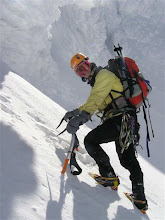
In this picture, I'm already about a third of the way up the route. My belayer (person protecting me from falling), is at the top of the route, out of sight, and the rope is going from his belay device down to my harness. He lowered me down the route, and then I started climbing up it. If I were to fall, then I would fall at most a foot or so due to the stretch in the rope (so, it's pretty darned safe!). I'm wearing a yellow jacket and orange helmet. Unfortunately, you can see neither the top nor the bottom of this route in this picture:
(For those who are familiar with the routes, this was called "The Plunger" in the "Shithouse Wall" section - according to the map, it was a WI4.)

In the below picture, I am looking at a vertical section, wondering how in the heck I'm going to get up it:

And in this next picture, I've succeeded climbing that vertical section, and just have a few more verticals to go before topping out. Right about this time, my hands started killing me, they were so cold, so just a few feet up from where I am in this picture, I found a good place to stand and warmed up my hands, as it was a bitterly cold day - I think that it was around 16F (-9C):

In the above 3 pictures, you can see the ropes that others have strung up for some of the other routes in this area. Fortunately, no one was climbing near me, so I didn't have to worry too much about ice from them falling on me, or ice that I knocked down, falling on someone else. Unfortunately, my belayer didn't have the same luck when he climbed the same route right after me, as there was someone practicing lead climbing (this means that the person doesn't have as much protection as someone who is top-roped, as I was, so if they get hit with ice, and it causes them to fall, they could be gravely injured) next to him, so he had to be extra careful not to knock down ice, lest it fall on that person. Since we have to kick at the ice to get footholds, and whack at the ice with our ice tools for handholds, not having ice fall down is pretty difficult. . .

In this next picture, I've topped out, quite happy at the success, with my belayer, in the lower right of the picture, sharing the happiness:

The three of us only did this one route that particular day. I did many more with others over the course of the week, but. . . no pictures!

On my last day, during the afternoon, I wound up being by myself, so I practiced a technique that we use to get multiple people up a rope that is fixed at the top of a route (prussik on a rope) which most of the other climbers (including the guides) in the area hadn't considered, so they were curious as to what I was doing. This made for some interesting exchanges of various techniques, making a nice end to a week full of practice and learning. . .

Stay warm (but not hot!)!!!

Friday, December 26, 2008

Pictures from the Aconcagua climb

Wim put captions on about 50 pictures, in case you're interested. I've not had a chance to sort through all of our pictures, yet, to pick out my highlights. . . I do still plan on doing that.

Here's the link to his captioned photos:
http://picasaweb.google.com/lh/sredir?uname=waarts&target=PHOTO&id=5281574567411851122&aid=5281562510427949505&authkey=ziLVun6eDyk&feat=email

leora

The return home

Returning home was quite the adventure. Aaron was able to fly from Mendoza to Santiago on the same day as the rest of his trip home, and except for a delay or two, and getting in a tad later than expected, seems to have had a fairly uneventful trip home. Wim and I had to fly into Santiago the day before the rest of our flights, since there wasn't an early enough flight from Mendoza, Argentina to Santiago, Chile, before the first leg of the rest of our flights, headed to Sao Paulo, Brazil. So, we had to actually look for a place to stay in Santiago when we got there. And, because the US apparently charges Chilean residents to enter the US, Chile has a nice little "reciprocity fee" that they charge US citizens upon entering Chile. $131.00 US dollars. It's good until your passport expires. The last time I went to Chile, I had a different passport, so I got to pay the reciprocity fee, again. Wim, a Dutch citizen, didn't have to pay this fee.

We took a taxi to a place that Wim remembered some hotels located that he discovered when he was browsing the web for places to stay, earlier. It was around 9pm, so we just took the first hotel we saw and then went in search of some street food, which we found - sopapillas! Sopapillas were round little (about 4.5" in diameter) deep-fried breads. A salsa, mustard, ketchup, and hotsauce were provided to put on top of the bread. I put the salsa, mustard (which was a tad sweet), and hot sauce on mine. They were so good that I kept going back and getting another. I think that I went back about 5 times. Wim found some meat on a stick, and also tried some mini-pizzas. I was still hungry, so we continued to search for more street food, but all of the vendors had already packed up and were clearing the streets. We found a low-end restaurant that was still open, and we shared a salad. I got to have Pisco Sour, and Wim had beer. The next morning the in-hotel breakfast was better than the Argentinian Tang + Croissant by having REAL orange juice, yogurt, and some sort of corn flakes cereal in addition to toast and jam. We checked out of the hotel and went in search of a bus to take us to the airport, but we managed to walk by the place where the airport bus left, and, running short of time, we took a taxi to the airport. We'd left all of the luggage that had our gear in it at the airport, so we picked that up and checked in. Wim and I had the same flight to Sao Paulo, but from then on, we had different flights, with me expecting to arrive in Portland around 1pm Christmas Eve, and he expecting to arrive around 8pm Christmas Eve. We'd heard that Portland airport had been closed, and other airports had had lots of cancellations, but we'd also heard that the weather was improving, so we were hoping to bypass all of the pain and agony of canceled flights, and closed airports.

I called Wim's wife while at Denver (my route was Santiago->Sao Paulo-> Toronto-> Denver-> Portland) and it turned out that Wim had been able to get a direct flight to Portland from Chicago, expecting to arrive roughly when I was to arrive. Anna Maria didn't know about the state of the Portland roads, yet, so didn't know if she'd be able to pick us up, but, whatever, Wim and I both needed to go to his place (it's where I'd left my car), so it was good news that he was expected to arrive at the same time. My flight to Portland was delayed some, but not too much, and when I went to pick up my bags, I was greeted by Anna Maria! It turned out that the roads were fine from their place to the airport, so she was able to show up to pick us up. We went down to collect my bags so that we could load up her car, but my bags didn't show up. When we reported the bags missing, they told us that they were on the carousel in Denver. Oops. . .

Anna Maria and I went up to wait for Wim. He arrived, but since his bags hadn't been rerouted, he didn't have any luggage to pick up, either - they'd arrive that night, likely. We went to Wim's. His street wasn't plowed, and in Oregon, salt isn't used, so my first test was to see if I could drive my car out of their neighborhood (there was a huge hill). After several false starts, and several incidents of getting stuck, I zoomed up the hill and out of there! I hoped that I was home free. I wasn't. The 40 minute drive from Wim's to my place took over 3 hours. While the highways were mostly ok, most cars were going fairly slowly, since there were still lots of chunks of ice, or ice/snow separating lanes, and generally, people seemed to be gun-shy after several days of treacherous conditions. The conditions got worse the closer I got to home - and by the time I got to Banks, some 10 miles from my home, I had to put on chains, as there was a sign requiring them, and the road was covered with snow, so it wouldn't have been safe without them. My chains aren't easy to put on, so I spent 15 to 30 minutes futzing with them, and finally headed toward home. One of the chains loosened about a mile later, so I stopped and corrected the situation. Then about 1 mile from my place a big pickup truck in front of me had stopped and was in the middle of the road. I pulled over and stopped, and noticed that the problem was a tree had come down over the highway. It was arched over the highway, so we all got out of the cars and started breaking off the smaller branches, hoping to create a tunnel to drive through. We got such a tunnel, that was good enough for my car, but not yet good enough for the truck, but I told them that I was taking off - I didn't mention that it was because I'd been traveling for over 24 hours with no more than 2 to 3 hours of sleep. . . The last part of the drive to my house is about 1 mile on a private road. This road hadn't been plowed at all, and the closer that I got to my place, the less traveled the road was. I started slipping and a-sliding, but was still able to make progress, all the way to the mouth of my driveway, and then the snow was just too deep, and my car couldn't plow it's way in any further, so I walked down my driveway, and entered my cold house. The power was out. The temperature outside was hovering around 32F/0C, and the temperature inside was 41F/5C. It was late, and I was tired - I called my neighbor who was watching my cat and house for me to let her know that I was back, and learned that the power had been out since Sunday, so this was now the 4th day. I got out a sleeping bag and went to sleep.

The next day I got out a camping stove and heated some water for breakfast. It was feeling a little like being on the mountain. I have a wood stove, but the stove pipe leading from the stove to the chimney is rusting out, leaving big holes through which sparks could fly, so I didn't want to start that up. I finally realized that I had to get the house warmed up, so I wrapped the stovepipe with some aluminum, and got the wood stove going. Since I have a well for water, no power means that there is no water, either. I started melting snow (there is over 2 feet of it, outside) for water to use to flush the toilets. I already had lots of bottles of water to use for drinking. I was REALLY feeling as though I were still on the mountain. The wood stove got hot enough for me to use that for cooking. I took everything out of the freezer and dumped it into the snow outside my dining room door. A lot of it was still frozen, which was very encouraging. I started cooking everything that had started to thaw. The living room and upstairs of the house warmed up to a nice and toasty 53F/12C. My neighbors got reports that the power wouldn't be restored for possibly another 4 or 5 days, so I figured that this would continue to be the life. The good news was that I finally had time to read. This was definitely a difference from the mountain - there, I hardly ever had a chance to read - there was always too much to do - either getting ready (sorting gear and food) for a carry, or having to melt snow/cook, or putting up or taking down the tent - there was always something. Here, the "tent" was my home, and there were no carries to plan, so getting wood, melting snow, and cooking were the big tasks, none of which take too much time, so I got my chance to read. (Jim Wittaker's "Life on the Edge" - memoir of the first American to climb Mt. Everest - in case you're interested. . . A very good read.) Wim called to tell me that he'd picked up my bags, and informed me that one of his bags had, for some reason, been sent back to San Francisco. . .

Today, I thought that I might start the arduous process of getting my car into my garage, but with 1/10th of a mile of driveway, it's a huge task to do by hand, but I started it, anyway. I removed the first 20 feet or so of snow. It's VERY heavy (the over two feet of snow has now consolidated, greatly, and is packed in to about 1.5 feet with a couple of layers of crusty ice). . . I returned to the house and had just stoked up the fire so that I could cook some more when the power came on!!!! Yippee! We'll see how long that lasts - so much snow is on trees that they are still falling due to all the weight of the snow. For now, though, I think that this mountain journey is now over. (Well, will be when I pick up my bags from Wim!)

Stay warm and healthy! And Happy Holidays!

leora

Wednesday, December 17, 2008

Aaron and Wim summitted, I did not. We´re off the mountain, now.

Hi, all - The last several days have been a bit of a whirlwind. We had some great weather when we needed it, and a few snowy, windy days that gave us an excuse for a rest day - actually of the 15 days that we were on the mountain, we only had 2 rest days that I can remember (I´ll have to double-check that, later). The 2nd rest day was sort of pre-determined for us: I was just asking over from "my" tent to "Arron and Wim´s" tent (for most the trip, I stayed in Aaron´s 2 person tent, and Wim and Aaron stayed in my 3 person tent) whether they wanted to "rest or carry", today. They told me to go to their tent so that we could discuss. Just when I got into the tent, we heard someone outside. I looked out, and saw a guy sort of collapsed (on his knees) outside our tent. I quickly re-put my boots back on, and ran over to him. He couldn´t feel his fingers, anymore, and wanted a drink of water. I ran back to my tent, got a bottle of water, which I then had to "serve" to him, since he couldn´t use his hands. I then ran back to the tent, got out my high altitude mitts and we took off his wet mittens and put mine on him. Wim suggested that he go into the tent. We got him into Wim and Aaron´s, and then Wim and I got the stoves going to get more water (we spent hours each day melting snow, turning it into water, boiling water for our breakfasts and dinner). We fed him breakfast (I happened to have an extra, as I hadn´t finished the previous night´s dinner, so ate that for my breakfast). Aaron sat there talking to our guest all morning long. By mid-day, he was feeling fine, having recovered feeling in his fingers and toes, and took off. For us, the day was pretty shot, so we declared it a rest day. The unfortunate thing for us, though, is that we were really getting antsie - Aaron was even thinking that if we had to have another rest day, he´d rather go down than try to go up. However, we´d already done a carry to Berlin - our highest expected camp, so we had stuff up there that we didn´t want to leave.

The following day, we moved to Berlin. We asked all the guides that we came into contact with what they´d heard about the weather. We were hearing that the following day was supposed to be good weather, with diminishing weather the following days. This was great for us, as the following day was our summit day.

Summit day: we had some hiccups - Wim completely overdressed and had to change - I needed to change out my pants, but couldn´t do it where Wim made his clothes change as it was too steep and in the middle of the trail. So, we wasted a lot of time at the beginning of the summit bid. Aaron mentioned something about the timing - until then, we´d not established a turnaround time, and I´d just assumed that we´d get there whenever we got there. Aaron and Wim pointed out that every afternoon bad weather came in, and I mean EVERY Day, so they wanted to be coming down before then. I got slower and slower as we got higher and higher. We had about 1000 meters/3280ft to get to the top. Wim had been having a lot of issues with the altitude the previous days, and was assuming that he´d have them on summit day. I told them to go on past me. After they continued up, I continued for a while, but had to keep stopping. I couldn´t seem to find ANY pace that I could sustain for more than about 10 paces. I remembered my friend, Monty, telling me that he would step once, and then take 3 breaths, and then take another step. I tried that, but couldn´t even maintain that. I assumed that I would just go as far as I could, and meet Aaron and Wim while they were coming down, and who knows, get there, myself (as I had always assumed that I would), but at some point, all I wanted to do was sleep (we´d gotten up at 2 am that day). I looked for a rock to lie on, and tried to take a snooze. I knew that I would regret not going up any further, but I just couldn´t get any motivation from anywhere inside myself to keep going up (and where else would the motivition come from?). I saw that there were people who were moving extremely slowing that at least kept trying to go up, and I wanted to be one of those people, but, again, couldn´t muster the motivation to move myself. I asked many of the people who were descending whether they summited (in Spanish and English), and they hadn´t because of a variety of reasons.

Finally, someone coming down had summited, and to me, it just meant that Aaron and Wim would be down in a couple of hours, rather than that I should even try. It finally occurred to me to at least mark the spot that I´d gotten to, got out my GPS, and found out that I was at roughly 6593 meters (21,630ft) (the summit is at about 6960 meters/22840ft). To myself, I was thinking that that should have been motivation to at least go another 7 meters up to make it a nice 6600 meters, but, again, I just couldn´t find the motivation. I looked down and saw a rock near the path in the snow that I thought would make a good place to sleep and headed for that. I did spend a lot of time looking around at all of the peaks that used to tower above us when we were down below, and now were below me - the sight was just phenominal! Glacier clad mountains - just wonderful! Later, thinking about it, I think that lack of oxygen was definitely at the heart of my inability to move, think, and get motivated. Wim and Aaron showed up, fairly wiped out, themselves, having succeeded getting to the summit 10 minutes shy of the turnaround time. Clouds had indeed moved in, and they told me that visibility by the time that they´d summited was so poor that I don´t even think that they had a good southern view. I told them that that was ok, since I´d already seen the view! One of the summiters was so happy and proud of himself that when he stopped to chat with me on his way down, he showed me the pictures that he´d taken using his digital camera (does anyone have any other type of camera, these days?).

Anyway, re-united with Aaron and Wim, we made it back down to our Berlin camp. That night, when I would wake up for my hourly pee/drink, I noticed that I would sometimes have to make a choice: take a drink, or breathe. If I drank, I would then have to sort of gasp in order to get enough oxygen. If I didn´t drink, I knew that I would get a headache (if I didn´t already have it). This was definitely not a nice part of the whole high-altitude experience. The views, the mountain, itself, up high, were all fantastic, but the headaches, constantly having to drink, and consequently, having to pee, were just not very happy-making. I looked forward to being down and not having to drink/pee so regularly.

The following day, after the normal several hours of melting snow (and this time, having to boil all of it, as we´d just run out of the iodine tablets that we´d been using to purify all unboiled water as, although they´ve instituted a policy where all trash, and all solid human waste must be carried off of the mountain, there is still a ton of human excrement, everywhere), we packed up camp, and headed down. We´d "cached" food and clothing at each of the lower camps, and now had to pick them up on the way down. First, everything we had at Berlin, then the cache at Nido de Condores, and then the cache at Camp Canada. When we got to base camp at Plaza del Mulas, I had us weigh each of our loads, using the fish scale that Inka Expediciones uses for weighing the loads for putting on mules. It turned out that I was carrying about 68 to 72 pounds (about 31 to 33 kilograms), and Aaron and Wim were carrying well over 38 kilograms, each (over 84pounds!) (They had a hard time lifting the load with the fish scale in order to accurately weigh them!).

When we set up camp, again, for the night at Plaza del Mulas, we felt as though we´d already arrived in civilization: sit down toilets (never mind that they were boxes over a barrel), water out of a spigot (water captured on the nearby river and piped down to a holding tank, from whence a spigot allowed the water to flow), air that we could breathe (ok, so it was still very high altitude, but to us, who´d spent about the last week up higher, we weren´t having to make the choice between breathing and drinking). And our Inka Exdediciones hosts were gratious and welcomed us back with drinks (Tang) and some slices of bread, olives, and meat.

The following day, yesterday, we packed up most of our equipment and left over food for the mules to carry out, gave away our left over fuel and olive oil, and headed out for the 35 kilometer (22mile) hike out. Aaron and I both are suffering from blisters on the bottoms of our feet. We all have sunburns on our faces - Aaron and Wim from summit day, and me from the last day - we usually re-applied sunscreen at LEAST every 2 hours - the rays are fierce up high, but apparently we were either lax, or the rays even fiercer than we expected, or we didn´t apply the sunscreen very well . . .

After getting to the park entrance, we told the guy from Inka who picked us up that we were hoping to make the bus back to Mendoza *that* evening - and it was supposed to leave in only 20 minutes. The guy was wonderful, and radio´d the Inka person in Penitentes, told him that we wanted to make the bus, and by the time we got to Penitentes, all of our bags (that the mules had carried out) were waiting for us - they loaded them up in the pickup that we´d been picked up in, and our driver drove us to where the bus was supposed to pick us up. Unfortunately, the bus driver didn´t want to pull up to where we were waiting and mostly Wim and Aaron got all of the very heavy bags to the bus. But, we made the bus, and went back to our friendly little hotel at midnight, and fortunately, they had "our" rooms still available. . .

So, this was my first opportunity at an internet. It was very nice to sleep through the whole night and not have to pee. . .

We´ll see if we can change our flights. It´s unlikely, as so many segments are involved and we´re using frequent flier miles for many of the segments, but we´ll be trying, anyway.

Pictures will have to await our return. . .

Saturday, December 06, 2008

5th day on the mountain and everything is fine!

We´ve been to Confluencia, on to Plaza del Mulas, and done 2 carries (1 carry more than expected) up to Camp Canada, and will move there, tomorrow.

Getting to Plaza Del Mulas was definitely an experience - 29km and a nice steep ending to get to this place. However, the snow that we endured during that 29km hike was well worth it - the place is absolutely SPECTACULAR!!!! (and this was supposed to be the ugly route!) We were all very winded when we got here, and on the second day, the same thing. Walking across the camp completely winded us. After the 1st carry, however, walking around here is a piece of cake!

This is extremely expensive, so I´m cutting it short. (and there won´t be more facilities like this higher on the mountain, I´m very sure!)

leora

Monday, December 01, 2008

Update - All of the bags have finally arrived!

Although the bags arrived 2 days late, we expect to be only 1 day behind on the schedule, as we´ve already packed some of the bags for the mules with the gear that did arrive. Wim and Aaron went to the airport just in time to see Aaron´s bags arrive (we had called the airlines multiple times during the day, with not hopeful info coming to us. . .), and were able to pick them up. This likely saved us several hours.

We´ll be re-packing them in mule-weight bags, tonight, and leaving early tomorrow morning, hoping to get to Confluencia only 1 day late.

Hope that everyone is doing well (there are fewer people on the mountain than expected, and many have canceled their expeditions due to the economic situation, which is affecting everyone all over the world).

leora

Sunday, November 30, 2008

What´s an expedition without something going wrong?

Well, only 3 of our 6 checked bags arrived with us. My one bag arrived the next day, but we´re still waiting for Aaron´s two bags. This means that our schedule is delayed by at least one day. We should still be ok, schedule-wise, but it just adds a little "excitement" to the trip!

Saturday, November 22, 2008

Before the Climb

As many of you know, I'm about to depart (this Friday!) to attempt Aconcagua, the highest peak outside of Asia at 6960meters/22,840feet. We'll see how I feel afterwards, but right now, I'm thinking that some of the hardest part of the climb has been done/is being done, now, before the climb even begins. Or, I suppose, the other way of looking at it is that the climb has already begun, and started way back in May.

For me, the first time I ever heard of Aconcagua was in 2000, when one of my running buddies, Monty, headed out to climb it. He'd climbed all over the Northwest, but was about to do this big mountain. I went to his slideshow about it when he returned, and the climb, itself, gave plenty of stories for many runs to come. At the time, I liked the idea of it, because it was a mountain, but it didn't look particularly pretty to me, and, well, I just wasn't ready for doing such a climb. By then, I'd climbed Mt. Hood, once. I knew that I enjoyed climbing, and I remembering feeling jealous that someone was about to do this sort of climb, but other than that, there were no thoughts in my mind of doing the climb, myself.

Now, with probably over 70 attempts and 52 successful climbs of Cascade peaks, I have a different viewpoint. And now that I've actually been to Mendoza, and hiked in the hills very near where we'll be, I see that there is beauty there, in the many colors of the mountains, if not in the snow covered peaks that are part of the Andes. I *am* interested and ready, psychologically, to do the climb. We'll see if I'm ready, in other ways, if I successfully summit and return, safely!

So, back in May, a couple of guys asked me if I were interested in joining them on Aconcagua. As I prepare to go next Friday, those 2 guys are NOT going this year, so I'll be going with 2 other guys, Wim and Aaron. Just agreeing on WHEN to climb turned out to be a multi-month discussion, honed when Wim joined the team and was limited in timeframe by his work, and finalized only when Aaron joined the team, and was limited by when he could get flights using his frequent flier miles. If he couldn't change his itinerary from his previously planned Vietnam trip using frequent flier miles to this itinerary, he wouldn't be able to go. So Wim and I waited for him to get his flights, and then we got our flights to match, fortunately, also using frequent flier miles, saving somewhere between $1200 and $2000 dollars, each, in airfare (airfare was soaring due to the soaring price of fuel at the time). Our flights were booked by mid-August.

With tickets to get to South America bought, the climb started to become a reality. We spent some time trying to decide what route we should do, since route would change logistics, and potentially the equipment list. Neither Aaron nor I have climbed higher than 14,400 ft (~4400meters), before (the height of Mt. Rainier in Washington state), so for us, going to 22,840ft should be a challenge in and of itself. Base camp for Aconcagua is similar to being on top of Mt. Rainier. Cold and wind are expected to be our other major challenges. I've never done an expedition, before. Doing one of the "walk up" routes definitely sounded like a good plan, as it would reduce the weight we needed to get up and down the mountain, enormously, if we didn't have to worry about ropes, harnesses, and all of the other gear associated with doing a technical climb. Having decided on a walkup route, we then had to decide WHICH of the walk-up routes we'd do. One is longer and less traveled, which was immediately appealing to us, but that also meant that we had to plan more time to get up the mountain, and, since we are going early on in the season, might mean that river-crossings would be challenging due to snow-melt. We finally elected to do it the absolutely easiest way, by taking the Normal Route, and stick to merely the cold, wind, and altitude challenges.

Having chosen the route, we moved on to the other planning. We talked to a whole bunch of people who have done the climb, before - in-depth discussions about logistics, experiences, trials, pitfalls, and highlights. We created a "to do" list, as well as equipment, food, schedule, and "conditioning" lists. We talked to more people. We obtained other people's lists. Wim and I attended Monty's latest slideshow on his Everest attempt. We went out and bought the same gloves that Monty used. We bought new boots - everything that I was reading was saying that I should be using plastic boots, but my new last-boots-I-will-ever-have-to-buy mountaineering boots that I bought earlier this year, were not plastic. Wim bought a new backpack. We lucked into a huge discount on a specific brand of gear, so I bought my second expedition tent, this one for 3 people (my other expedition tent is a 2 person tent), and a 40 degree below sleeping bag (-40 is the same in both Celsius and Fahrenheit temperature systems!) that actually fits into my backpack! We went on conditioning hikes to test out our new backpacks and boots, and to get our backs used to carrying large loads (although each hike, we've successively *reduced* our loads - not the normal training), as well as for trying out various snack foods. Since getting enough calories in high altitude is an issue, we were trying out various granola bars/candies to find out which were absolutely delicious. If they aren't delicious at sea level, they won't be palatable at altitude.

The conditioning hikes proved to ourselves that we have a good team as far as talking goes - we chatter at each other constantly, which makes the miles melt away. And our climbing philosophy as far as climbing this mountain goes, is the same, which is VERY important. Tensions can soar if one person thinks that the climb should be done in a week, while others want to take more time, for example.

Wim and I have climbed some difficult routes, together, multiple times, and Aaron and Wim have climbed difficult routes, together, multiple times. The three of us, however, have only gone ice-climbing together, and not really as a team - Aaron and Wim were climbing together, and I was sort of wandering around from one team to another. So, the conditioning hikes were important to get us all synced, discussing climbing philosophies, in general, and for Aconcagua, in particular, and finding out how we three got along together, as a team. Do we watch out for each other? Do we even *like* each other? 20 days straight on a mountain can be a really, really long time, so it's best if we all get along with each other!

I went on my previously planned 3-1/2 week trip to Argentina. I was lucky - my fellow travelers were also interested in Mendoza (the starting place of the expedition, where the climbing permits have to be obtained), hence, we went there, and I was able to contact a company that organizes muleteers and mules to carry equipment to base camp, and find out about how to get fuel for the stoves (since we can't take that onto the airplane!). I got experience with the bus system and even got to see one of the trailheads for one of the routes up Aconcagua. I reserved a couple of hotel rooms in the same hotel in which Ed, Rebecca and I stayed. I learned where the permit office is, the best way to get money and where the ATMs were located, and where Carrefour (the big supermarket) is located, should we need to make any last minute food purchases once we are down there.

Meanwhile, Wim and Aaron dealt with the drugs. They visited a doctor who is quite knowledgeable about high altitude climbing (being a doctor, a climber, and interested in high altitude climbing, himself), and got us perscriptions to deal with the various maladies we hope that we will never get, and were taught about the symptoms and what is actually going on, and what the drugs actually do to the body. They talked to more people, and set up a private slideshow for when I returned to the US, with another climber who successfully climbed Aconcagua starting with a 3 person team. That slideshow turned up other topics of discussion (When is it ok to leave someone from the team alone on the mountain? What should we take for reading material, if anything?).

We've created a schedule that is extremely generous with acclimatization, and still leaves time to wait out storms, and wait for a good weather window to summit, yet only spend the 20 days maximum allowed by the park service. We hope that through this extremely generous acclimatization schedule (3 to 4 days at each camp!), that there will be no need to dip into the drug supply. . .

I've spent hours making up ziplock bags of dinner and breakfast foods. Lunches, in general, are expected to be cold snacks, so I have set those aside, too. The ramen-type noodles that my friends from Taiwan have been religiously supplying to me whenever they come to the US is a staple in my dinners. I love the taste of these noodles, and the flavor packets are strong enough that I can add bulgar wheat, rice, or couscous to the soup, some soy protein, and still think that the whole thing is yummy! Since drinking 4 to 5 liters a day is difficult, but necessary in the dry high altitude air, I've also brought along a lot of soup mixes, and drink mixes. My problem is that I have too much food set aside, (I'm at about 2.5 pounds per day, whereas I think that 2 pounds should be the max, and Wim is even thinking 1.5 pounds per day should be plenty) and will have to get rid of some stuff before we head out. Not sure, yet, what will be removed. . .

Tomorrow, we'll be meeting at Wim's to actually pack everything - make sure that we have proper bags for balancing loads for the mules, and also for getting everything onto the airplane. And, to double check everything against our equipment lists. We're expecting this to be an almost 1 day activity.

And, maybe, just maybe, I'll be able to get in another climb before heading out, early Friday!

(I'm enclosing our schedule, in case it is of interest to people. . .)

Saturday, November 15, 2008

Iguazu Falls, Argentina

Hi, all - I'm back from 3-1/2 weeks (Oct. 17 through November 10th) of traveling in Argentina, with the final two days spent in Uruguay. Iguazu Falls, in Argentina, was the first place that we headed.

Rebecca (wife of a high school buddy), Ed (high school era and travel buddy), and I met at the airport in the Dallas-Fort Worth, Texas:
and then flew down to Buenos Aires, got a taxi from the international airport to the domestic airport and got on the first plane out to Iguazu Falls. These falls are absolutely spectacular. I've had people send me power point slides of these falls, and I've seen websites of friends who'd gone before me, so I already knew that I'd be in for a treat, but being there just makes it all so much more real, and, well, so much more spectacular. We'd reserved two days to actually visit the falls, and I'm glad that we did, as one day would just not have been enough for us.

The falls:

The first day we wanted to get a little exercise, so we chose to start out with a hike to one of the smaller falls. The hike turned out to be longer than expected (3km just isn't that far, but it sure felt as it if were!), but we amused ourselves with the plants, birds, and butterflies (many, many) that we saw along the way. Here is a montage of some of the many different types of butterflies that we saw:
We then took a little park train and went to what was supposed to be the most spectacular part of the falls, and therefore suggested to be saved for the last. The book warned us that we should expect to get soaked. This being spring, down there, it was actually quite warm, so getting wet wouldn't be a problem, and we decided to go see that fall, next. The train let off at a path that was at least 1/2 mile from the platforms looking over the falls. The path was mostly an elevated walkway with a metal grating that allowed one to look down at the wide, wide river running below the walkway. We saw, first an anteater, and then hawks and cormorants on the way.

This picture is to give you just some idea of the walkway to the falls - we're already almost there, having gone at least 2/3rds of the way, already, all the way walking over smooth, shallow, river. You can just make out the tops of some of the falls in the distance, and the mist from others:

When we got to the overlook platform, there were tons of people. We joined the crowd. We got soaked as the spray from the falls was whipped back up and around us by the wind. We looked into "the Devil's Throat" and were absolutely entranced by the amount of water, the speed of the water, the roar of the water, the long drop of water, and, the spray. This was a very Niagra-looking/feeling waterfall. And like Niagra, where another country is on the other side of the river, here, Brazil was on the other side. We kept watching the waterfalls, and eventually, would be the only people around! The next trainload would come, and for a while, we'd be surrounded by many others, until they moved on, and then would once again, be some of the few standing around. We stayed for hours, partly because we tried to get in a "your magazine was at Iguazu Falls" picture with a local newspaper near Ed's place. We never succeeded in getting that picture - the winds were just too unpredictable, causing drenching actions very often. We took a ton of photos, none of which can possibly capture the feeling, the sound, the experience. We saw swallows diving under some of the waterfalls into their nests behind the waterfalls! This was a very, very, very captivating sight, indeed.

Here is one that attempts to show what I think of as the mouth of the falls (The Mouth of the Devil's Throat, if you will. . .):
The above was just off to my right on the big platform. Moving the camera farther to the left, I could see all of these falls raining down from Brazil:
And then looking off to my left, at the other falls falling down from the Argentinian side of the river, there were these - see if you can see the birds just about to dive into the waterfalls to get to their nests:
The falls produced so much spray that it was rarely possible to see down to the river, below, since the water was coming from all sides and just pouring into this narrow little canyon. The roar was intense!

When we'd finally decided to depart the falls, leaving the rainbows, roar, and wet, behind, we were absolutely drenched. The sun came out to warm us, and by the time we got back to the train, we were dry!

We'd had a pretty full day so decided to just head back. While others were in the rest room, I was looking out at the green grass, and noticed some animals scurrying about. We asked and were told that they were guinea pigs. Some were almost a foot long, so they seemed a little different than the ones that we have in the US:
We had our tickets stamped on the way out so that the following day, we could get in at 1/2 price.

The following day, as we packed to get ready for our second and final day at the park, we reviewed the material for the falls and determined that it would be a "dry" day. That is, the part of the falls that we were going to visit wouldn't be sending mist all over us, and the wind wouldn't be whipping it against us - we were going to be just too far away from this other set of falls. We returned to the park (the bus ride in from the town was about 1/2 hour) and bought our 1/2 price tickets. Right after getting in, Ed noticed a park ranger standing around, and decided to go and talk to her, telling her that he, too, worked for the park service, but in the US. She told him that he didn't have to pay, then - Argentina extends a "professional courtesy" to park employees from other countries to enter their parks, free. However, he had paid. She brought us back out of the park to go into an office where there were some other park officials, and introduced Ed and Rebecca and me to the others there. I thought that we were just having a chat, but what was really going on was that she was trying to make up for Ed having paid for two days. They asked us if we'd taken the boat, yet. We hadn't. They told us that we should first go to the interpretive center, and then meet someone at 10am at a specific location. We went to the interpretive center, and there the people gave Ed a whole bunch of brochures and a couple posters (which he then left with them for safe keeping while we toured the park), and then went to the appointed spot. The ranger, Nancy, had arranged that the 3 of us should get a courtesy tour of the jungle by truck and the falls by boat by the vendor! Ed was in shock. In the US, not only do his friends who visit him have to pay to visit the National Historic Site where he works, but he has to pay to visit any other national park. And here, a park employee was able to get a park employee of another country, and his two friends, a free tour by a vendor working in the park!!!

On the jungle tour, the tour guide kept asking if anyone had questions. We realized that this was our opportunity to get all the questions we'd been accumulating from the previous day, answered. Even though there are plenty of animals in the jungle, we saw none of them on this particular tour. The next step was the boat ride. We were given life vests and drybags to place our shoes and anything that we were carrying, including cameras. They told us that we'd be able to take pictures until a certain time, and then they'd tell us to put it into the drybag and close it up. Oh, so we might get some spray. Maybe it wouldn't be such a dry day, after all. . . We sped up the river from down river of all of the falls. The river itself was fast-flowing, and we had a rapid or two to negotiate - the standing waves were high, so it gave some of the crew quite a thrill (and we rafters got a thrill, too, since they were impressive waves!). They drove us to some picturesque sight, gave us some time to take pictures, and then told us to put cameras into the dry bags. They then took us to the base of some of the falls so that we could experience the force of the falls. We experienced it, alright! We got mostly drenched. They then took us to the base of another fall. It appeared as though we were going to go right under the actual fall, but really, they only took us near to it, yet the spray was so intense that it thoroughly soaked us. Everyone on the boat was excited about the experience and called for them to do it one more time, so the guy turned around and dove back for the falls. We know that they do this multiple times a day, but it sure feels as though one time, they might just get it a little wrong, and the boat would be capsized in a moment. However, nothing untoward happened to us, but I definitely hung on for dear life, and was THOROUGHLY soaked by the time we'd done it, again, if not before. . . Looking at other boats doing the same thing, I saw them disappear in the mist at the base of the falls.

This was the view:
The mist at the base of the left-most falls is where the boat would disappear into, and then come racing back out.

Here is a more distant view of the above waterfalls, plus more of the surrounding falls:
The big white fall upper center of the picture are the falls that we went under in the boat. The falls to the far left of the picture are the falls coming down off the Brazilian side of the river in the place that we were, the previous day (fifth picture from the top of this article).

Some birds (2nd is a Turkey Vulture):

And more wildlife:

and:
I hope that this gives you some sense of the enormity of the whole thing. It was truly, truly impressive. And in addition to the falls, we didn't see such a variety of butterflies anywhere else, and this was the only place that we saw the anteater and the fairly large reptile pictured above, whose name I've forgotten.